
What Grant County Probate Covers
Probate is the court process for handling what a person owned at death. It also covers some matters that arise while a person is still living. In Oklahoma, probate is not a separate court. Grant County probate cases are filed as District Court cases and handled through the Court Clerk, in what people often call the Probate Division of the District Court. The same office that keeps civil and criminal files also keeps these estate files.
The work falls into a few clear buckets. A will is proven and an estate is distributed. A guardianship is opened for a minor or an incapacitated adult. A conservatorship protects someone's property. A trust dispute or trust filing is heard. State court records list these as Probate, Probate Miscellaneous Proceedings, Filing of Wills, and Trusts. Party roles include deceased, executor, administrator, personal representative, heir, guardian, ward, trustee, and trustor.
Because it all lives inside the District Court, a probate case looks much like any other court case. It has a case number, a docket, hearing dates, and orders signed by a judge.
A typical estate moves through a set sequence. Someone decides whether the matter is a will, a guardianship, a trust, or a small-estate issue. They search existing cases to see whether one is already open. If a court case is needed, pleadings are filed with the Court Clerk. Notices go out, hearings are held, and the judge signs orders. At the end, the personal representative requests certified copies and records any real-property transfer with the County Clerk.
Probate Terms Defined
Probate uses old words that confuse a lot of people. A short glossary clears up most filings. These terms show up on docket sheets, in petitions, and in the orders a judge signs.
- Testator
- The person who made the will.
- Executor
- The person named in a will to carry out its terms and settle the estate.
- Administrator
- The person the court appoints to settle an estate when there is no will or no named executor can serve.
- Intestate
- Dying without a valid will, which leaves the court to divide property under state law.
- Guardianship
- A court arrangement giving one person legal authority over a minor or an adult who cannot manage their own affairs.
- Conservatorship
- A court arrangement to manage the property and finances of a person who needs that help.
How to Search Grant County Probate Records
Two official paths cover most searches. The first is the Oklahoma State Courts Network, known as OSCN. The second is On Demand Court Records, known as ODCR, which the Grant County Court Clerk links as a free site with extensive case information. Both let you search by name or case number for Grant County District Court cases. Start with one, then cross-check the other.
- Open the OSCN Docket Search and set the County or Court field to Grant County District Court.
- Enter the decedent, ward, or person's name. Add a first name or a date range only if the results are crowded.
- Limit by District Court case type to Probate, Probate Miscellaneous Proceedings, Filing of Wills, or Trusts when you know the record type.
- Run the same name on ODCR as a parallel path. Free searches cover names, case numbers, and filed-date ranges.
- For older estate files, sealed matters, or records not online, call the Court Clerk or visit Room 202 in the courthouse.
Document images can be limited. ODCR lets the public read many docket entries free, but scanned images and advanced filters may be paid or restricted to bar members.
Where Grant County Probate Is Filed
Probate filings go to the Court Clerk, who keeps the District Court case files. If a probate result needs to touch land or mineral title, a related document may also be recorded with the County Clerk, the county's land-records office. The two offices sit in the same courthouse but do different jobs. The Court Clerk handles the court case. The County Clerk records deeds and other real-property instruments.
Grant County Court Clerk
Clerk: Adrienne Hembree
112 E Guthrie, Room 202
Medford, OK 73759
580-395-2828
Adrienne.Hembree@oscn.net
8:00 a.m. to 4:00 p.m. Monday to Friday
Grant County County Clerk
Clerk: Rachelle D. McCaleb
112 E Guthrie, Room 102
Medford, OK 73759
580-395-2274
8:00 a.m. to 4:00 p.m. Monday to Friday
Marriage, divorce, and probate files all live under the Court Clerk. The broader role of that office, including certified copies and request methods, is covered on the Grant County Court Clerk page.
Small Estate Affidavits in Grant County
Not every death needs a full court estate. Many people who search for "probate" really need a small estate affidavit instead. The Grant County County Clerk publishes the form. It applies to a decedent's deposit account that does not exceed $50,000 when no personal representative has been appointed and no application or petition is pending.
The affidavit rests on Title 6 O.S. 906. It identifies the affiant and their relationship to the decedent, attaches the death certificate, states the decedent died without a will, names the bank and the account, and carries a notarized signature. It lets a survivor collect a limited bank balance without opening a District Court estate. It does not transfer land or settle larger holdings.
The county lists the small estate affidavit alongside its deed and lien forms on the County Clerk forms page.
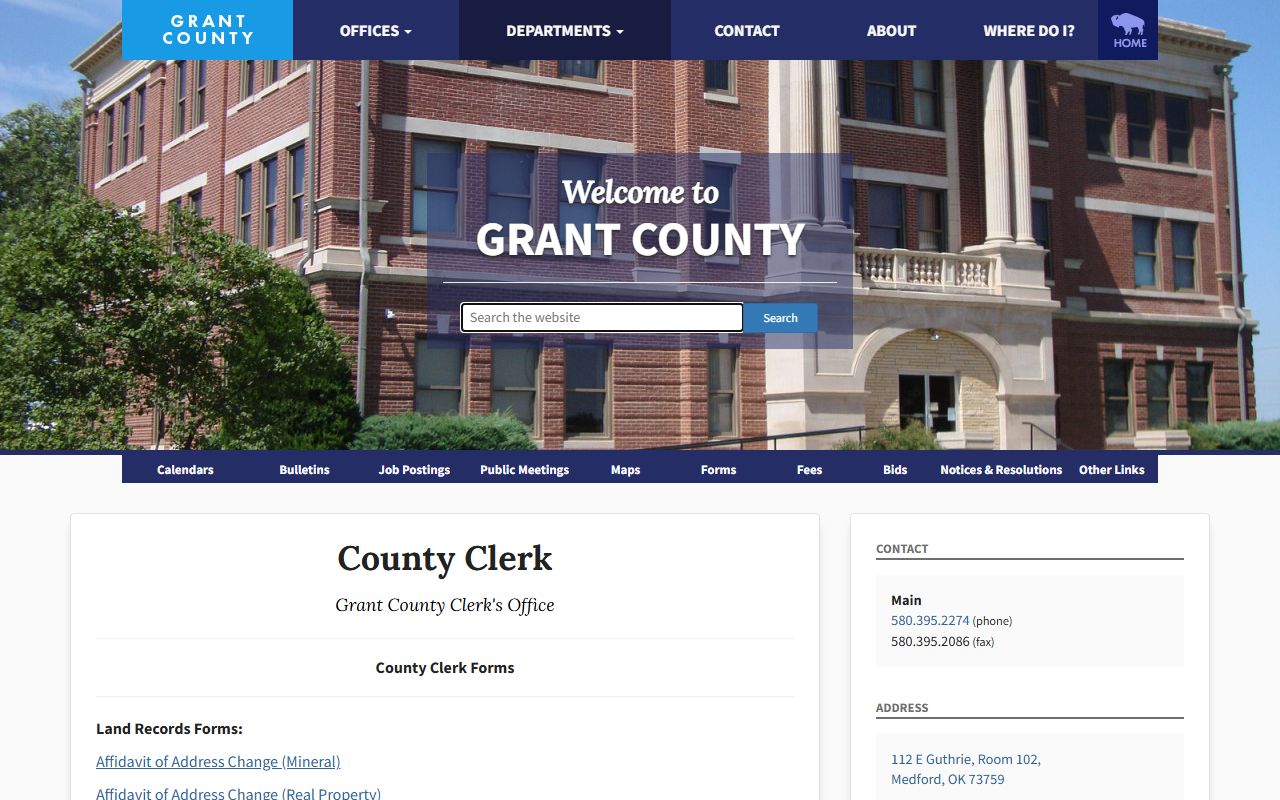
That same forms page holds the transfer-on-death deed, the affidavit of surviving joint tenant, and proof of death and heirship documents that often follow an estate. Reviewing the form set first can tell you whether a quick affidavit will solve the problem.
Grant County Probate Filing Fees
Court filing fees for a Grant County probate case were not published in the local sources reviewed, so confirm the current amount directly with the Court Clerk. What the county does publish is its recording fee schedule. Those charges apply only when a probate result, such as a judgment or a deed, is recorded in the county's land records by the County Clerk.
The Grant County fee schedule lists the recording costs that can attach to probate-related documents.
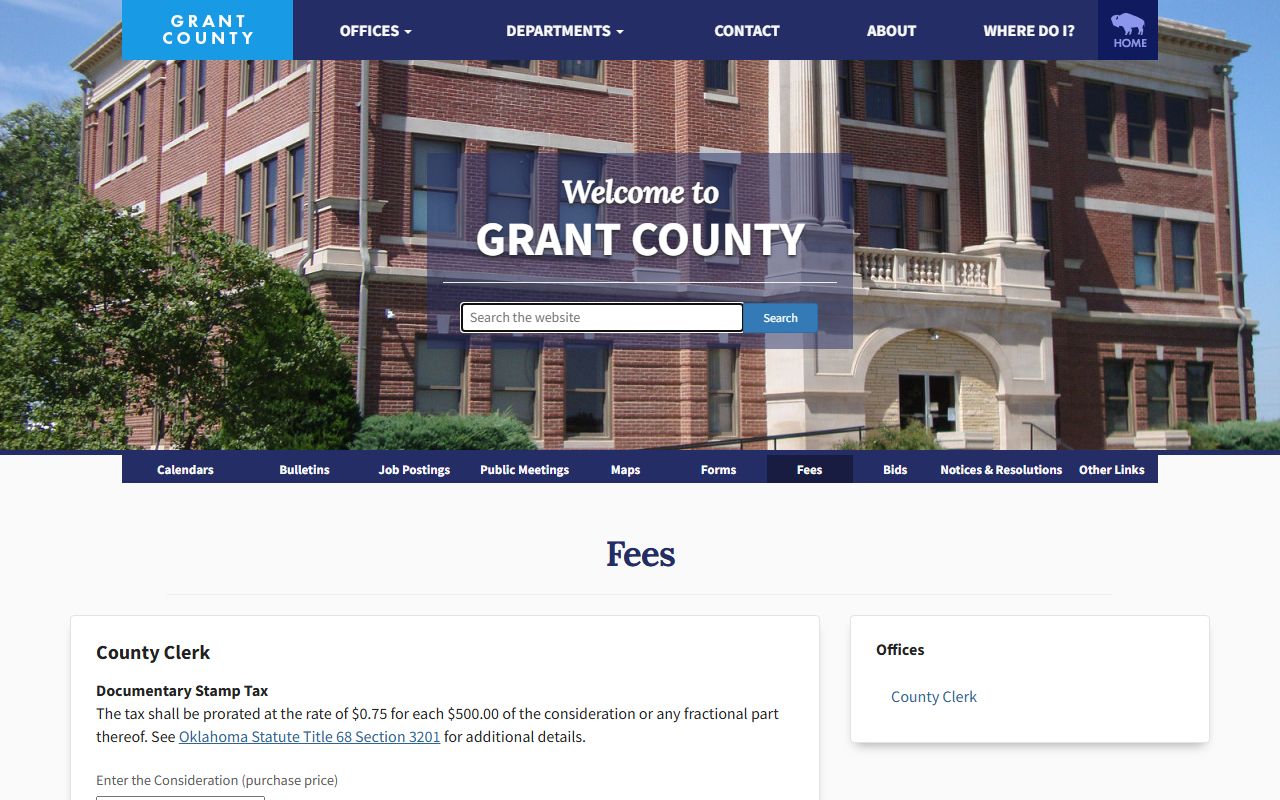
The figures below are county recording fees that may apply, not District Court probate filing fees. Treat the court filing line as a prompt to call the Court Clerk before you file.
| Item | Amount |
|---|---|
| Judgment recording, County Clerk | $8 |
| Each additional page | $2 |
| Certified copy certificate | $1 |
| Copy per page | $1 |
| Preservation fee per recorded document | $10 |
| District Court probate filing fee | Confirm with the Court Clerk |
Note: County recording fees are separate from court filing fees, and only documents actually recorded in county land records trigger the recording charges shown above.
What Grant County Probate Records Show
A probate docket grows as the case moves. Early entries open the file and prove the will. Later entries account for the property and close the estate. The financial and procedural detail can be dense, but the structure repeats from case to case.
- Case number, usually a PB or PROB type, plus filing date and status.
- Decedent or ward name, and the petitioner or applicant.
- Personal representative, executor, administrator, guardian, or trustee.
- Will filing, petition, notices to heirs and creditors, and the inventory.
- Appraisement, accountings, distribution, discharge, and guardianship reports.
- Hearing dates, the assigned judge, minute entries, and signed orders.
- Fees, costs, and any certified-copy requests.
Reading the docket in order is the fastest way to see where a case stands. The most recent order usually tells you whether the estate is open, closed, or waiting on a hearing.
Older Estate Files and County Recording
The Court Clerk's office holds court files from the early 1900s to the present. That long reach matters for genealogy and for old family estates. Records that predate the online systems may exist only on paper at the courthouse. A phone call or a visit to Room 202 is the way to reach them.
Recording is the other half of the story. When an estate transfers land or mineral rights, the resulting deed or order is recorded with the Grant County County Clerk. Land-record searches and recorded probate instruments live there, not in the court docket. Genealogists often need both offices, the Court Clerk for the case and the County Clerk for the title.
Note: Court files date to the early 1900s, but online coverage is shorter, so older estates may require a direct request to the Court Clerk.
Restricted Grant County Probate Records
Most probate files are open for public inspection. A few are not. The Court Clerk page lists three categories that are closed to the public: juvenile, mental health, and adoption records. A mental health commitment tied to a guardianship can fall into that protected zone.
Guardianship and conservatorship files raise extra care. They often involve a minor or an incapacitated adult, and details about health, finances, or safety may be limited even when the case itself is public. Sealed matters require a court order or a statutory basis to view. When a file you expect to find does not appear, that restriction, or a simple gap in online coverage, is usually the reason.