
Criminal Court Records in Grant County
A Grant County criminal court record is the case file the District Court opens when someone is charged with a crime. The Court Clerk keeps that file. It holds every paper and order tied to the case, from the first charge to the final sentence. Local court files reach back to the early 1900s, and most stay open to the public. The clerk's office in Medford is the home for these records. Each criminal case carries its own number, and the file grows entry by entry as the matter moves through court.
The District Court is the trial court for Grant County. It hears both felony and misdemeanor cases. A felony is a serious crime that can bring prison time. A misdemeanor is a lesser crime with lighter penalties. Both types produce a court record. Traffic crimes filed in the District Court land here too. City ordinance offenses are handled in municipal courts, such as Medford Municipal Court, and those files stay with the city rather than the county clerk.
How to Search Grant County Criminal Records
Most Grant County criminal court records can be searched online at no cost. Two systems cover the county. The Oklahoma State Courts Network, known as OSCN, offers a statewide docket search. On Demand Court Records, or ODCR, is linked by the Court Clerk and also lists Grant County. Start with one system, then check the other if a case does not appear.
- Open the OSCN docket search and set the court to Grant County District Court.
- Search by the defendant's name, or enter the case number if you have it.
- Narrow the results by case type and filing date. Use CF for a felony, CM for a misdemeanor, and TR for traffic.
- Open the case to read the docket, the charges, and the disposition.
- Ask the Court Clerk for a certified copy when you need an official version.
Some records sit outside the online systems. Older files, sealed cases, and paper-only matters may need a direct request. The Grant County Court Clerk in Room 202 can pull these. The office holds court files from the early 1900s forward. Records are open for public inspection, except juvenile, mental health, and adoption matters.
Stages of a Grant County Criminal Case
A criminal case moves through set stages, and each one leaves a mark in the record. The file starts when charges are filed. It ends at sentencing, or sooner if the case is dropped. Reading the docket in order shows where a case stands and what comes next.
Case flow: Charges Filed › Arraignment › Pretrial / Motions › Plea or Trial › Disposition › Sentencing
| Stage | What Happens |
|---|---|
| Arraignment | The defendant hears the charges in open court and enters a first plea. |
| Pretrial / Motions | Lawyers file motions, share evidence, and set hearings; bond may be set or changed. |
| Plea or Trial | The case ends in a plea, or it goes to trial before a judge or jury. |
| Sentencing | After a guilty plea or verdict, the judge sets the penalty, such as fines, probation, or jail. |
Prosecutors and Defenders in Grant County
Two offices shape a Grant County criminal case once charges are filed. The District Attorney prosecutes for the state. Tommy Humphries serves as the District Attorney for District 4, which includes Grant County, and works from the courthouse in Medford. The DA decides which charges to file, handles plea talks, and recommends sentences. The named prosecutor appears in the case record.
A person who cannot afford a lawyer may receive appointed counsel. The Oklahoma Indigent Defense System, or OIDS, provides that defense across most of the state. The OIDS how-do-I page explains how appointed representation works.
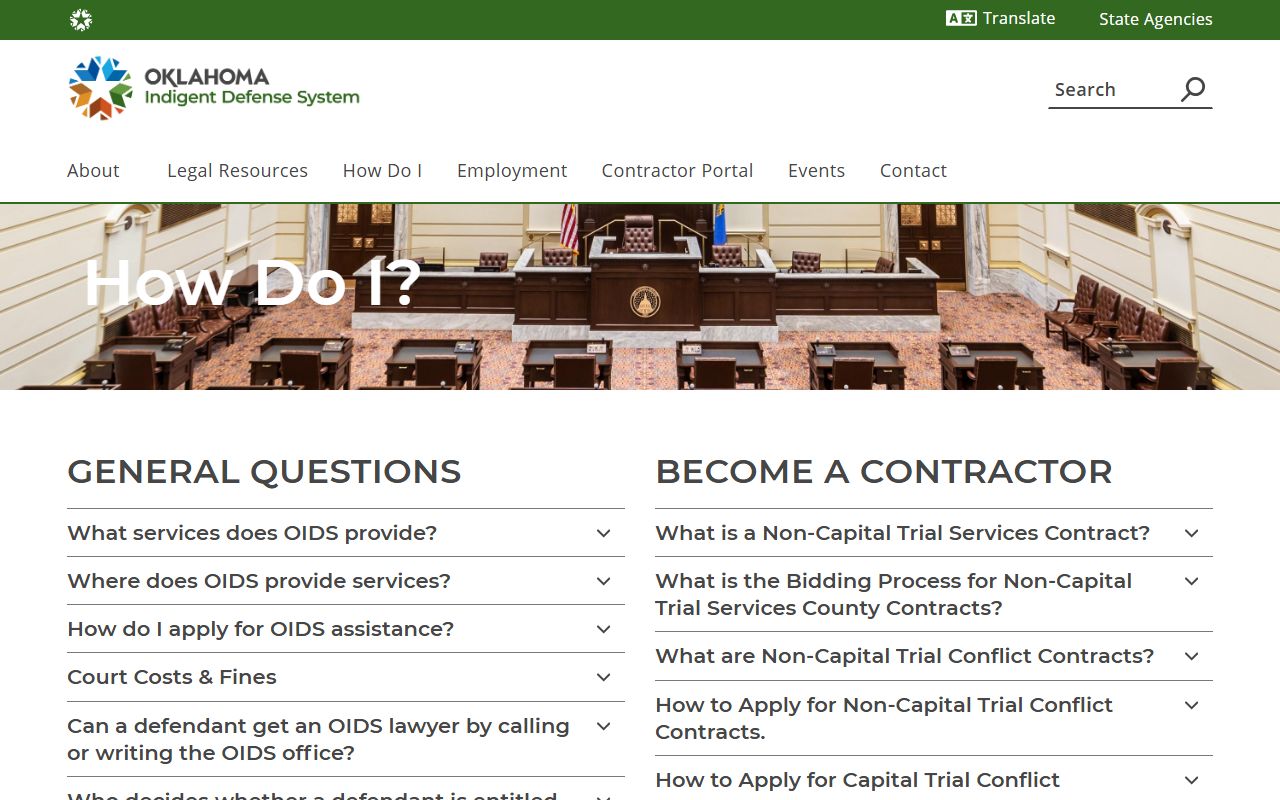
OIDS handles trial defense in felony and misdemeanor cases, plus appeals, when the court finds a person cannot pay. The docket often shows an application for appointed counsel and an OIDS attorney listed for the defendant.
The agency works across 75 counties at the trial level and all 77 at the appeal stage. Its statewide role is laid out on the Oklahoma Indigent Defense System page.
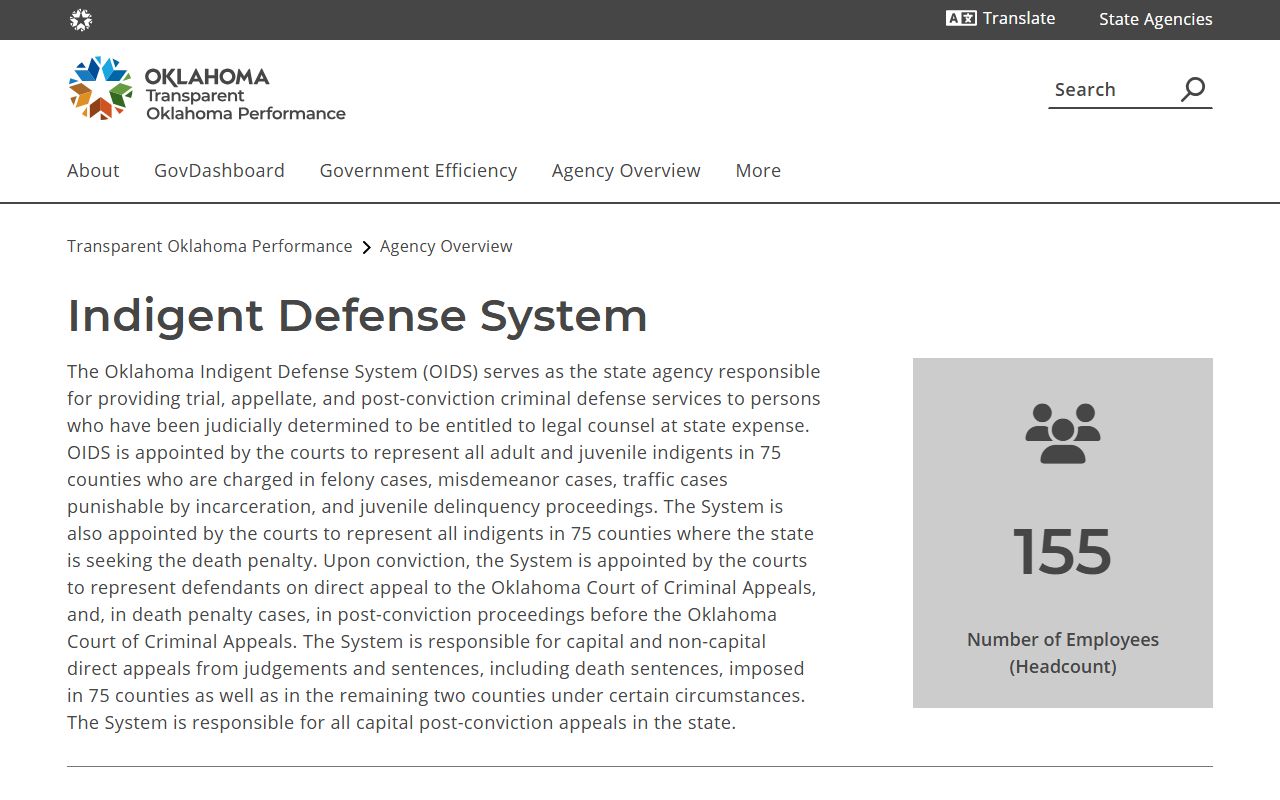
When you read a Grant County criminal record, the listed prosecutor and defense attorney tell you who argued each side of the case.
What Grant County Criminal Records Show
A criminal court record packs a lot into one file. The fields below show what a Grant County case file holds. Together they trace the case from the first charge to the final sentence.
| Field | What It Shows |
|---|---|
| Case Number | The unique ID, such as CF-2025-12; the letters mark the case type and the year. |
| Defendant | The person charged, listed with name and sometimes a city of residence. |
| Charges | Each count, tied to the statute the person is accused of breaking. |
| Plea | How the defendant answered, such as guilty, not guilty, or no contest. |
| Disposition | The outcome of each charge, such as convicted, dismissed, or acquitted. |
| Sentence | The penalty set by the judge, such as fines, probation, jail, or prison. |
The file also tracks bonds, hearings, motions, court costs, and fees. The financial section can run long, since each fee posts as its own line. Court costs, a law library fee, sheriff fees, and a DA prosecution fee are common entries.
Charges vs. Convictions
A charge is not a conviction. Many people read a criminal record and assume the worst, but the two are far apart. A charge is only an accusation. A conviction is a proven result. A Grant County record can show charges that were dropped, dismissed, or that ended in a not-guilty finding. The deeper look at how charges are filed and how they change lives on the Grant County arrest records and court charges page.
| Charge | Conviction | |
|---|---|---|
| Stage | Accusation | Verdict or plea |
| Burden of Proof | Probable cause | Beyond reasonable doubt |
| Public Record | Yes | Yes |
Reading Dispositions and Sentences
The disposition is the heart of a criminal record. It tells you how each charge ended. Short codes and phrases carry the meaning, so the terms are worth knowing before you read a file.
- Guilty
- The defendant admitted the charge or was found guilty by the court.
- Not guilty
- A judge or jury cleared the defendant of the charge.
- Dismissed
- The court dropped the charge before any finding of guilt.
- Nolo contendere
- A no-contest plea; the defendant does not admit guilt but accepts the penalty.
- Deferred sentence
- The judge delays judgment while the defendant meets set conditions.
A deferred sentence matters later. If the defendant finishes the terms, the plea can be withdrawn and the case dismissed. That result opens a path to update the record, which Oklahoma law allows under its deferred-sentence statute.
Sealed vs. Expunged Records
Some criminal records are removed from public view. Oklahoma uses two tools: sealing and expungement. They are not the same. Sealing hides a record from the public. Expungement goes further and treats the record as if it never existed.
| Sealed | Expunged | |
|---|---|---|
| Visibility | Hidden from public | Destroyed / treated as never existed |
| Law Enforcement | Limited access | Very limited |
| Eligibility | Court order under the sealing procedure in 22 O.S. 19 | Person fits a category listed in 22 O.S. 18 |
The Oklahoma State Bureau of Investigation explains how criminal-history expungement works and what it costs.
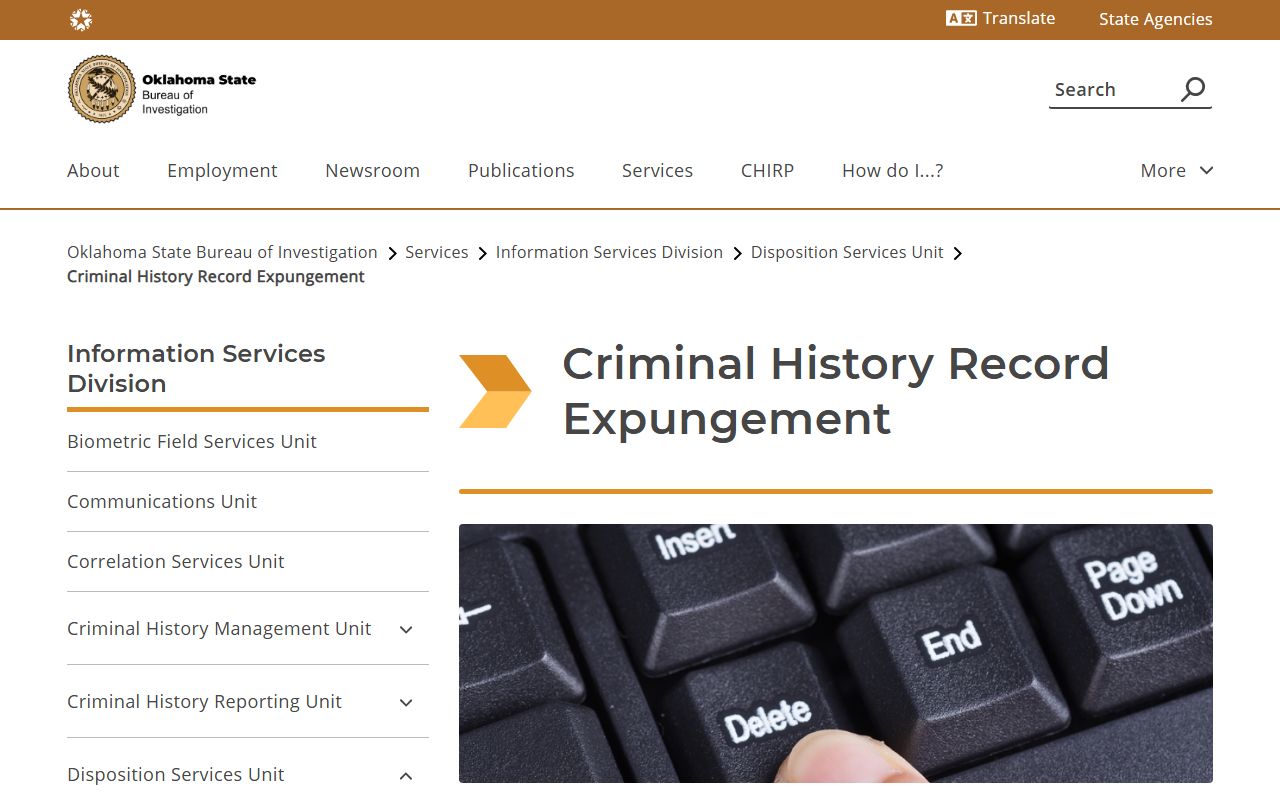
OSBI sets out which records qualify, the fees that apply, and the steps to ask a court for relief. The agency is the state keeper of criminal-history data.
Expunging Grant County Criminal Records
Expungement in Grant County starts with eligibility. Oklahoma law splits the process in two. A full arrest-record expungement runs under 22 O.S. 18, which lists the people and situations that qualify. A separate path under 22 O.S. 991(c) lets someone who completed a deferred sentence update the case to show a dismissal, though it does not erase the arrest record.
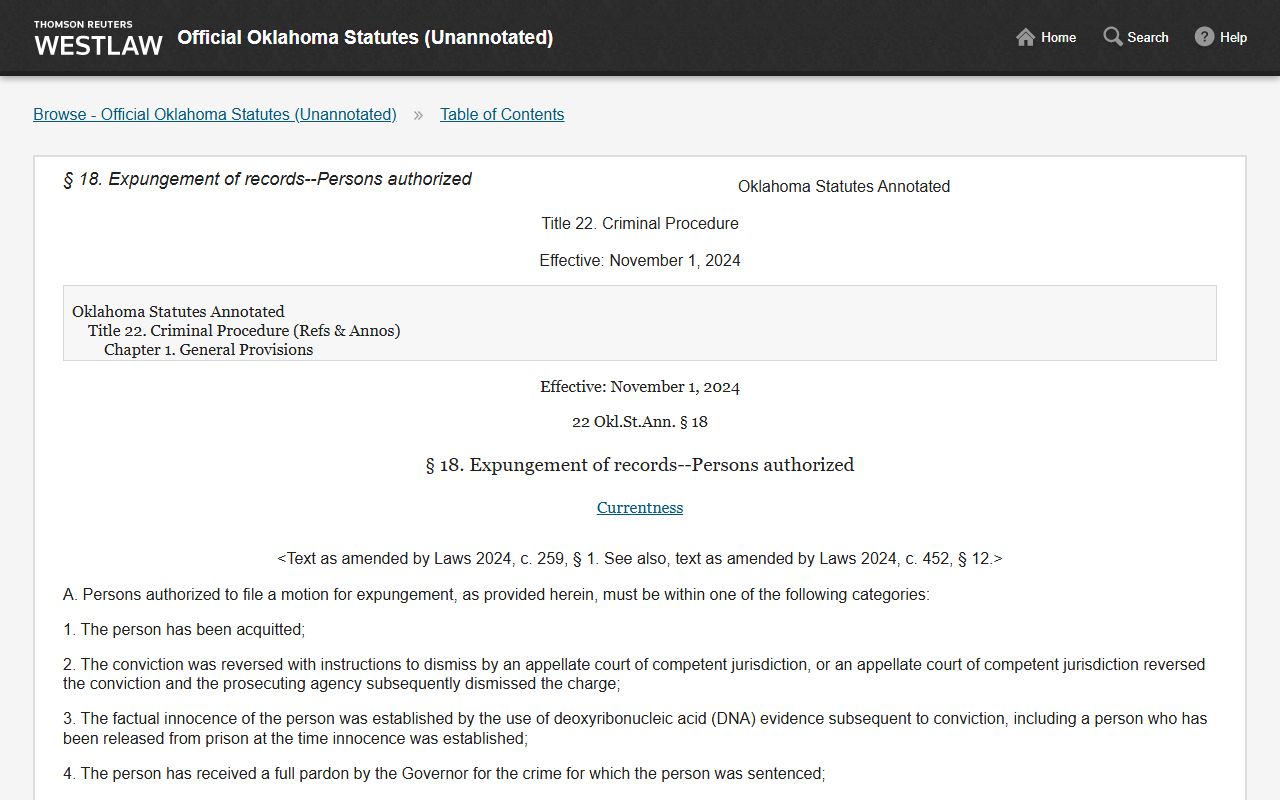
The categories that qualify for a full arrest-record expungement are set out in the statute itself, 22 O.S. 18.
Cost depends on the type. OSBI says expunging a court record is free. Expunging an arrest record carries a $150 OSBI processing fee, and local law-enforcement fees may apply. OSBI takes a cashier's check or money order, not a personal check. The petition is filed in court, notices are served, and agencies seal the records if the judge grants the order. OSBI recommends a lawyer, since the rules and deadlines are strict.
Public Access to Grant County Criminal Records
Criminal court files in Grant County are public records. Oklahoma's Open Records Act sets that rule for state and local agencies. The Court Clerk page repeats it: court files are open for inspection, with a few exceptions. That open-access default is why OSCN and ODCR can post dockets online for anyone to read.
Key Statutes:
Oklahoma Statutes § 51-24A.5 - Public records stay open for inspection and copying during business hours unless a law makes them confidential.
Oklahoma Statutes § 22-19 - Sets the court procedure for sealing or unsealing a record after an expungement request.
Restricted Criminal Court Records in Grant County
Not every criminal record is open. Some are closed by law, and some are held back while a case is active. The Court Clerk withholds three set categories from public inspection, and other limits apply case by case.
- Juvenile cases, kept confidential under 10A O.S. 2-6-102.
- Mental health matters tied to the court.
- Adoption records.
- Sealed and expunged cases, hidden by court order.
- Sensitive details, such as a minor victim's name, which may be redacted.
An active investigation can also keep parts of a file out of view. When a record is sealed, online searches will not show it, and the clerk cannot release it without a court order.
Background Check Considerations
People often pull criminal records for hiring, renting, or licensing. Those uses fall under the Fair Credit Reporting Act, a federal law with strict rules. A casual name search is not the same as an FCRA-compliant background check. For an employment or tenant decision, use a screening firm that follows the law and gives the subject proper notice.
Important: This site is a privately run resource, not a consumer reporting agency under the FCRA, and its information cannot be used for credit, employment, tenant, or other FCRA-regulated decisions.