
Oklahoma District Court Structure
Oklahoma organizes its trial courts as District Courts. Every county sits in one. A District Court is a court of general jurisdiction, which means it handles nearly every kind of state case. The same judges hear civil and criminal matters, plus family, probate, traffic, and small claims. The state explains this dual role on the Oklahoma District Courts agency page, which notes that District Court judges decide both civil and criminal cases.
Three appellate courts sit above the trial bench. The Oklahoma Supreme Court leads civil and administrative matters. The Oklahoma Court of Criminal Appeals is the final word on criminal appeals. The Court of Civil Appeals takes many civil cases the Supreme Court assigns to it. City courts sit below the District Court and handle only municipal matters. In Grant County, that lower tier is the Medford Municipal Court.
For the public, the practical point is simple. Almost any state court record a person wants in Grant County is a District Court record. Felony and misdemeanor charges, divorces, estates, and most traffic citations all live in this one system, and two free state websites let anyone look them up.
Grant County District Court Judges
Grant County is a small, rural county, so the local bench is compact. An associate district judge sits in the courthouse in Medford, while a district judge listed for the county keeps an office in Enid and covers more than one county. The Court Clerk in Room 202 maintains the District Court files and dockets. The table below lists the local courts, judges, and offices a Grant County case may touch.
| Court or Office | Address | Phone | Notes |
|---|---|---|---|
| Grant County District Court / Court Clerk | 112 E Guthrie, Room 202, Medford, OK 73759 | 580-395-2828 | Holds District Court files and dockets. |
| Associate District Judge Hon. Jeff Crites | 112 E. Guthrie, Room 201, Medford, OK 73759 | 580-395-2258 | Local judge in the Grant County courthouse. |
| District Judge Hon. Paul K. Woodward | 114 W. Broadway Ave, Enid, OK 73701 | 580-237-5031 | District judge listed for Grant County. |
| Medford Municipal Court | Community Room, City Hall, 615 N. Front St., Medford | 580-395-2823 | City ordinance and traffic; meets second Friday of odd months. |
| Pond Creek city offices | 102 S. 2nd, Pond Creek, OK 73766 | 580-532-4915 | City contact; no separate municipal court search located. |
To search the cases these judges hear, start with the OSCN Docket Search and set the court to Grant County District Court. A second free path, On Demand Court Records, also lists Grant County. Both let you search by party name or case number.
The Grant County Courthouse in Medford
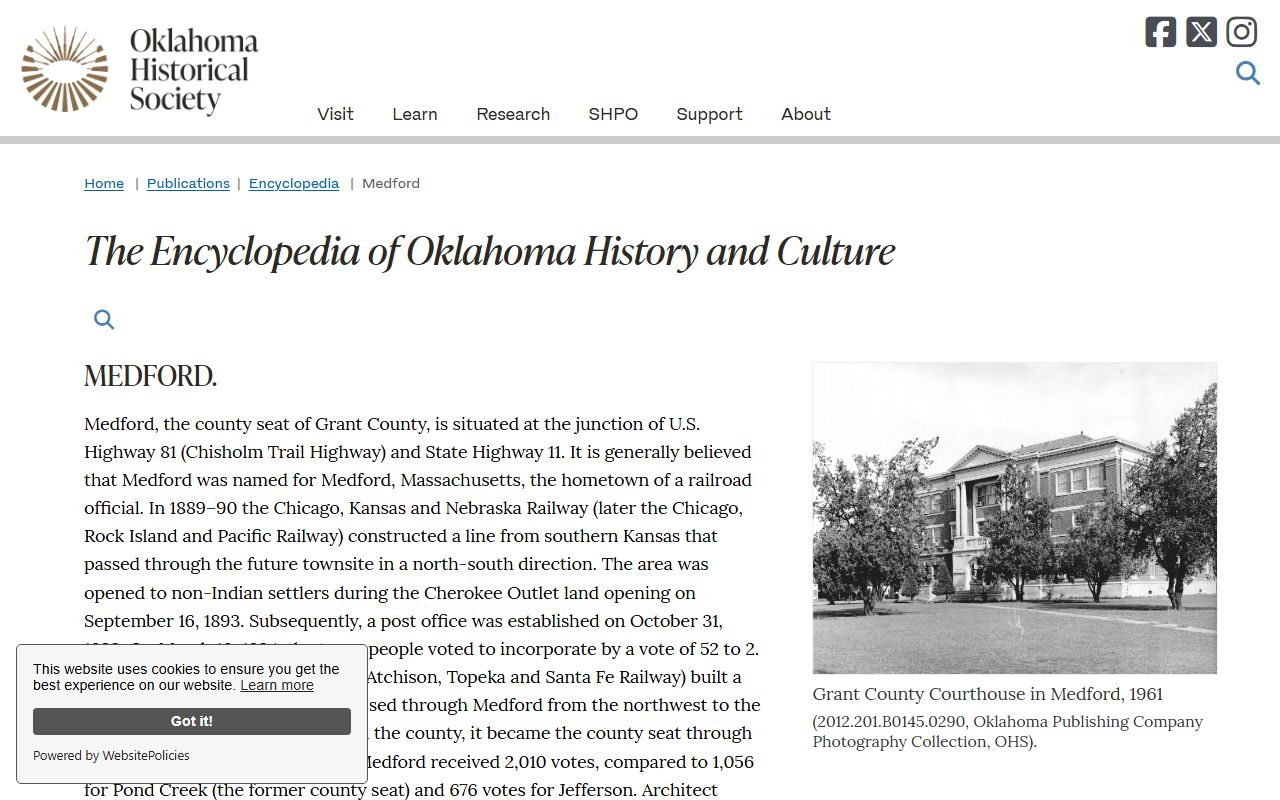
Grant County District Court operates from the historic courthouse at 112 E Guthrie Street in Medford. The three-story brick building went up in 1909 and was dedicated on July 4, 1910. It stands on its original site and joined the National Register of Historic Places on August 23, 1984. Inside, the Associate District Judge works from Room 201 and the Court Clerk from Room 202, while the County Clerk sits in Room 102.
The Oklahoma Historical Society's Medford history entry records the courthouse dedication and its place on the National Register.
Medford became the county seat in 1908, and the courthouse marked the town's shift to a permanent seat of government. That long run helps explain why the Court Clerk holds court files reaching back to the early 1900s. Older civil, criminal, probate, and marriage records may sit in the building even when they are not posted online.
Civil and Criminal Jurisdiction in Grant County
The District Court splits its work into broad classes, and the case-number prefix shows which one a record belongs to. Civil cases cover disputes that are not crimes. Criminal cases cover charges the State brings after an arrest. One court hears both, but the rules and the parties differ.
Civil filings in Grant County District Court include contract disputes, debt collections, money judgments, liens, injunctions, and name changes. The caption usually pairs a plaintiff against a defendant. Criminal filings split into felony and misdemeanor charges, with the State of Oklahoma as the moving party against a named defendant. A criminal file can run from the first charging document through bond, plea, trial, and sentencing.
Most of these records are open to the public. The full case file, including dockets and dispositions, can be reviewed online or requested from the Court Clerk. A deeper look at how to read a file lives in the county's court records pages.
Note: Juvenile, mental health, and adoption cases are the three classes the Grant County Court Clerk keeps closed to public inspection.
Family, Probate, and Traffic Cases in Grant County
Because the District Court hears everything, several specialized dockets run alongside the main civil and criminal calendars. Each one produces its own kind of record, and each routes through the Court Clerk in Medford.
- Family and divorce cases, including paternity, child support, and protective orders.
- Probate matters, handled in the Probate Division of the District Court, covering wills, estates, and guardianships.
- Marriage license records, which Oklahoma routes through the District Court Clerk.
- Traffic citations filed by the Oklahoma Highway Patrol or the county sheriff.
- Small claims actions for lower-dollar money disputes.
Protective orders and family files can carry redactions, since addresses and minor children are often shielded. Probate cases are generally open, though guardianship details touching a minor or an incapacitated adult may be sensitive. The Court Clerk can confirm what is available and what needs certification.
District Court vs Municipal Court
Not every case in Grant County is a District Court case. City ordinance violations and city traffic tickets belong to a municipal court, which is a separate system with its own records. The comparison below shows where the two diverge, which matters most when a reader cannot find a ticket in the state docket search.
| District Court | Municipal Court | |
|---|---|---|
| What it hears | State civil and criminal cases, family, probate, and traffic filed by state or county officers | City ordinance violations and city traffic tickets |
| Where records appear | OSCN and ODCR online dockets | Directly with the issuing city court |
| Grant County example | Grant County District Court in the Medford courthouse | Medford Municipal Court at City Hall |
| Schedule | Regular business days | Medford meets the second Friday of odd-numbered months |
| Appeals | State appellate courts | Reviewed through the District Court |
A municipal citation will not show up in the OSCN traffic citation search, which covers District Court only. For a Medford city ticket or fine question, the path is a direct call to City Hall at 580-395-2823 rather than a state docket lookup.
How a Grant County Case Moves
A case follows a set path through the District Court, and the docket records each step in order. Criminal and civil matters move differently, but both can end in an appeal. The flow lines below trace the common stages a Grant County file passes through.
Criminal flow: Arrest › First Appearance › Charges Filed › Arraignment › Preliminary Hearing › Plea or Trial › Sentencing › Appeal
Civil flow: Petition Filed › Answer › Discovery › Pretrial Hearings › Trial › Judgment › Appeal
Each stage leaves a docket entry with a date and a short description. A criminal docket may log probable cause, bond, appointed counsel, and a judgment and sentence. A civil docket tends to log motions, orders, and the final judgment. When a case finishes, the record shows the disposition and any balance owed.
Where Grant County Appeals Go
An appeal leaves the District Court and moves up to a state appellate court. The route depends on whether the case is civil or criminal. The split is a defining feature of Oklahoma's court system, because two separate high courts share the top.
Civil appeals go to the Oklahoma Supreme Court, which assigns many of them to the Court of Civil Appeals. Criminal appeals go straight to the Oklahoma Court of Criminal Appeals, the final word on criminal matters in the state. Federal cases are a different track entirely. They are heard in the U.S. District Court for the Western District of Oklahoma, not in the Grant County courthouse.
Prosecution and Defense in Grant County
Two offices shape the criminal side of the District Court docket. The District Attorney files and prosecutes charges, and the public defense system represents people who cannot afford a lawyer. Both appear by name in the docket entries of a criminal case.
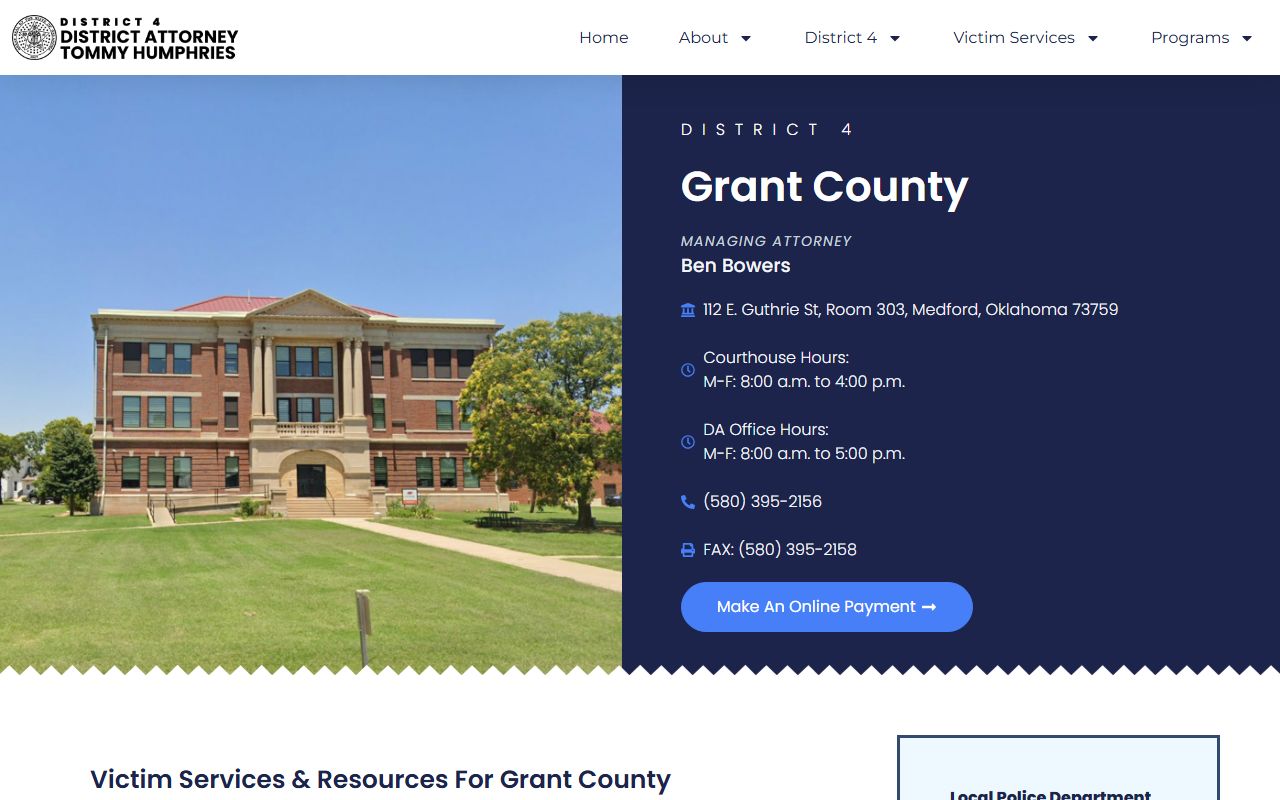
Grant County falls in Oklahoma District 4, and District Attorney Tommy Humphries works from Room 303 of the Medford courthouse. The District 4 District Attorney Grant County page publishes the office contact and hours.
On the defense side, the Oklahoma Indigent Defense System provides trial and appellate counsel for people a judge finds entitled to it. A defendant asks the court for appointed counsel, the court reviews financial need, and an OIDS or assigned attorney steps in when the standard is met. Both names then track through the case docket.