
What Is a Grant County Court Docket
A docket is a dated list of every event in a case. Each line records one action, such as a charge filed, a motion, a hearing set, a plea entered, or a final order. Read top to bottom, the docket gives the whole story of a case as a timeline. It is the fastest way to learn a case status without pulling the paper file.
A docket is not the same as the full case record. The docket lists what happened and when. The full file holds the actual documents behind those entries, such as the signed motions, exhibits, and orders. In Grant County, the District Court docket is the part most people can read for free online, while the underlying images may require a visit or a paid account.
Dockets cover the full range of District Court business. A reader might pull one to confirm a court date, check whether a judgment was entered, or follow a felony case from charge to sentence. Because each line is dated, the docket also shows how long a case has been open and how active it has been.
How to Find Grant County Court Dockets Online
Grant County dockets appear on two official sites. The OSCN Docket Search from the Oklahoma State Courts Network is the main statewide tool, and On Demand Court Records is the second path that the Court Clerk links directly. Both list Grant County District Court. A case number gives the cleanest result, but a party name works when you do not have one.
- Open the OSCN Docket Search and choose Grant County District Court from the court menu.
- Enter a case number if you have one, since this returns a single docket fast.
- If you only have a name, type a last name and add a first name to trim the list.
- Review the docket entries in date order to follow the case from filing to disposition.
- Run the same search on ODCR as a backup for participating Grant County courts.
The OSCN landing page also gathers dockets, e-payments, and help links in one place through the OSCN court records page. Both systems are free to search by name or case number.
Case Number Codes in Grant County Dockets
Every Grant County case carries a number built from a type code, the year, and a sequence, such as CF-2025-12. The two-letter prefix tells you what kind of case it is before you open a single entry. Learning the common codes helps you filter a search and read a result at a glance.
| Code | Case Type |
|---|---|
| CF | Criminal felony |
| CM | Criminal misdemeanor |
| CJ | Civil case |
| FD | Family and domestic, including divorce |
| PB | Probate |
| PO | Protective order |
| SC | Small claims |
| TR | Traffic |
| SW | Search warrant |
These codes appear in the OSCN case-type filter and on every docket caption. When the case type is known, limiting the search by code cuts down on false matches for a common name.
Calendar Events in Grant County Dockets
Many docket entries are calendar events, which are the scheduled court dates for a case. A calendar line usually shows the date, the time, the type of event, and whether it has been completed. These are the entries people check most often, because they answer one practical question: when does the next hearing happen?
Common calendar events in a Grant County criminal or traffic case include the initial appearance, the preliminary hearing, plea settings, and sentencing. Civil and family cases show motion hearings, pretrial conferences, and trial dates. A completed status on a line means the event has already taken place.
- Initial appearance, where charges are first addressed.
- Preliminary hearing, used in felony cases.
- Plea or disposition setting.
- Pretrial conference and trial date.
- Sentencing or final order.
Traffic Citation Dockets in Grant County
Traffic cases make up a large share of Grant County dockets. A citation written by a state trooper, a sheriff's deputy, or another state or county officer is filed in the District Court under a TR case number. These dockets can be searched by citation number on OSCN, which helps when you hold the ticket but not the case number.
A traffic docket usually shows the citation number, the offense, the law-enforcement agency, the court date, the disposition, and the fines and costs owed. The payment status sits on the financial lines, so a reader can tell whether a fine is paid or still open. OSCN does not search municipal citations, so a city traffic ticket has to be checked with the issuing city court instead.
Sample Grant County Docket Entry
Each docket line packs several pieces of information into one row. Knowing what each part means makes the list far easier to read. The table below breaks down the fields that make up a typical Grant County District Court docket entry.
| Field | What It Shows |
|---|---|
| Entry Date | The date the filing or event was recorded on the case. |
| Event Type | The action, such as information, bond, motion, plea, or order. |
| Party Filing | Who filed the entry, such as the state, a plaintiff, or an attorney. |
| Description | A short text line explaining the entry or court minute. |
| Amount | Any fee, cost, fine, or payment tied to that line. |
| Document Link | An image link when a scanned filing is available to view. |
Financial lines on a docket add up court costs, the law library fee, sheriff fees, and other assessments into a running balance. Document links may open only with a paid or bar-member account on ODCR, while the free docket text stays readable to anyone.
Paying a Grant County Docket Balance
When a docket shows money owed, Oklahoma offers an online way to pay District Court balances. The OSCN e-Payments service accepts credit and debit card payments for selected District Court cases and approved payment plans. It does not cover every case, so a balance that does not appear may need to be paid through the Court Clerk.
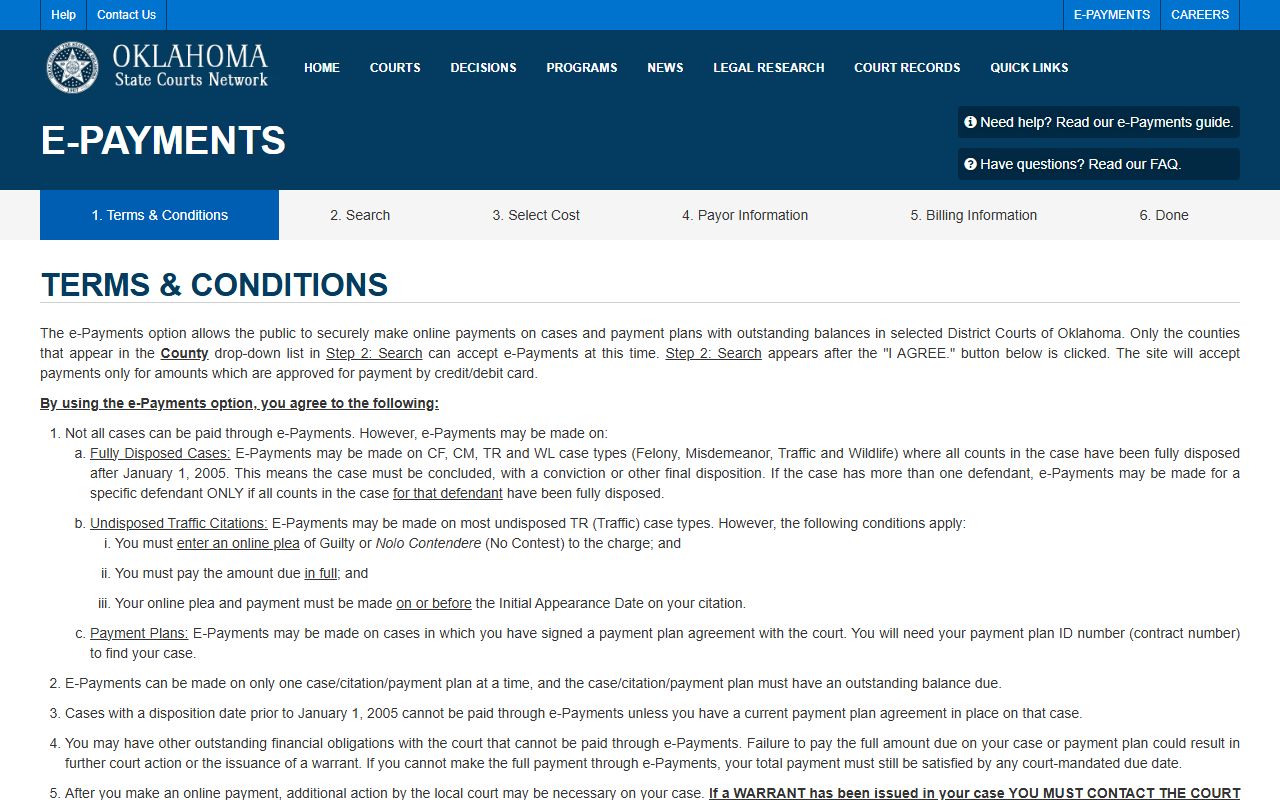
The terms page explains that payments run only for selected cases and approved balances, and it sets out the card rules before you reach the search step. After accepting the terms, you reach a search field that takes a case number, a citation number, or a payment-plan number.
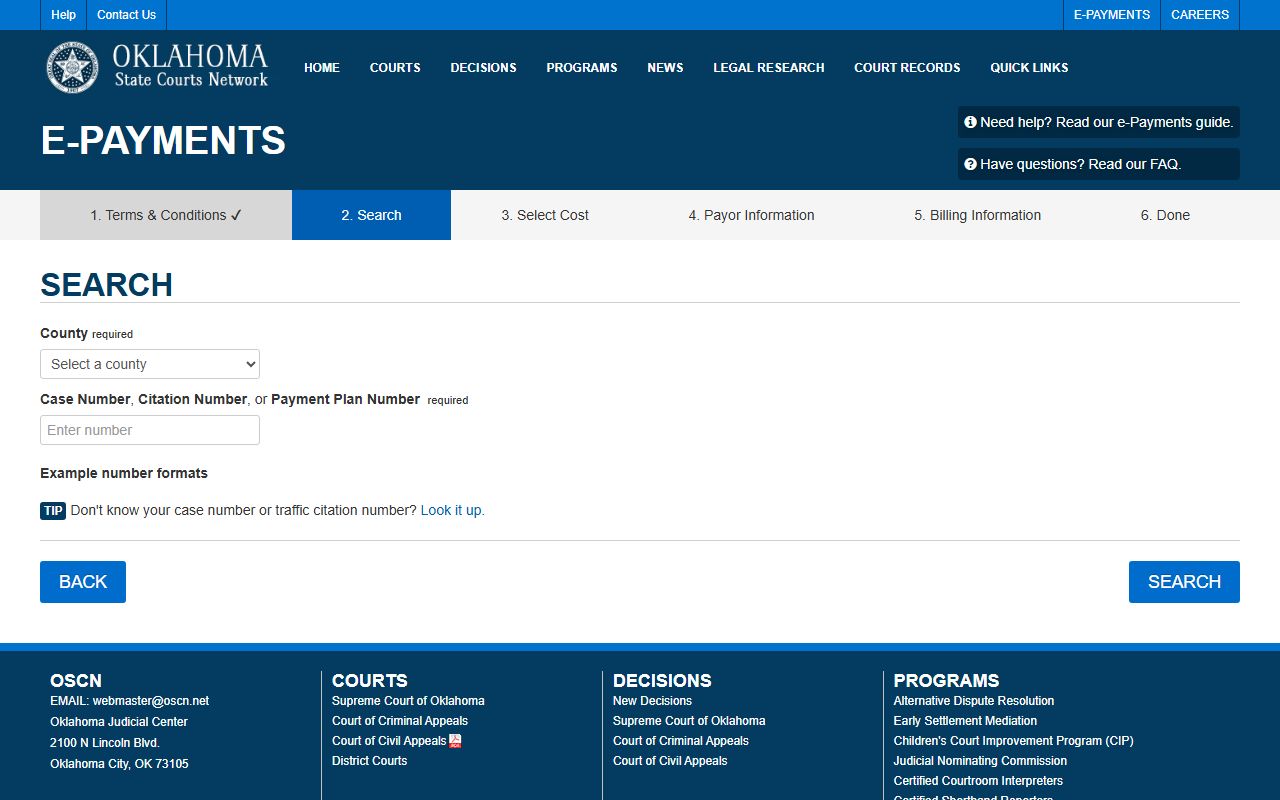
The search page on the e-Payments agreement step looks up the case and shows the balance before you confirm. This route is for District Court cases only. A municipal fine works differently and is paid through the city that issued the citation, not through this state tool.
Docket vs Full Case Record
The docket and the full case record serve different needs. The docket is a quick index of events that is usually free online. The full record is the stack of actual documents, which may cost a fee or call for a courthouse visit. The comparison below lays out when each one fits.
| Docket | Full Case Record | |
|---|---|---|
| Format | List of dated entries | Full filed documents |
| Access | Often online and free | May require a fee or visit |
| Cost | Free docket text on OSCN and ODCR | Paid images or certified copies |
| Best Use | Track case progress and dates | Legal review and certified proof |
The free docket text on OSCN and ODCR is enough for most needs. ODCR confirms that name, case-number, and filed-date searches cost nothing, and the docket entries read free. Scanned document images are the paid part: advanced ODCR tools run a small monthly fee, full District Court image access is reserved for bar members at a higher rate, and a single-court image plan falls between the two.
For a certified copy or an older paper file, the Court Clerk is the office to contact. Court copy fees are set locally, so confirm the current charge before you travel or mail a request.
City and Municipal Court Dockets
Not every Grant County case sits in the District Court system. City ordinance violations and municipal traffic tickets run through the city court that issued them, and those dockets do not appear on OSCN or ODCR. The Medford Municipal Court meets at City Hall and routes fine and case questions through 580-395-2823. A city ticket has to be checked with the issuing city, not the state docket tools.
Other Grant County towns keep their own city offices. Pond Creek lists its city officials, clerk, and contact details on the Pond Creek departments page, reached at City Hall on South 2nd Street and 580-532-4915.
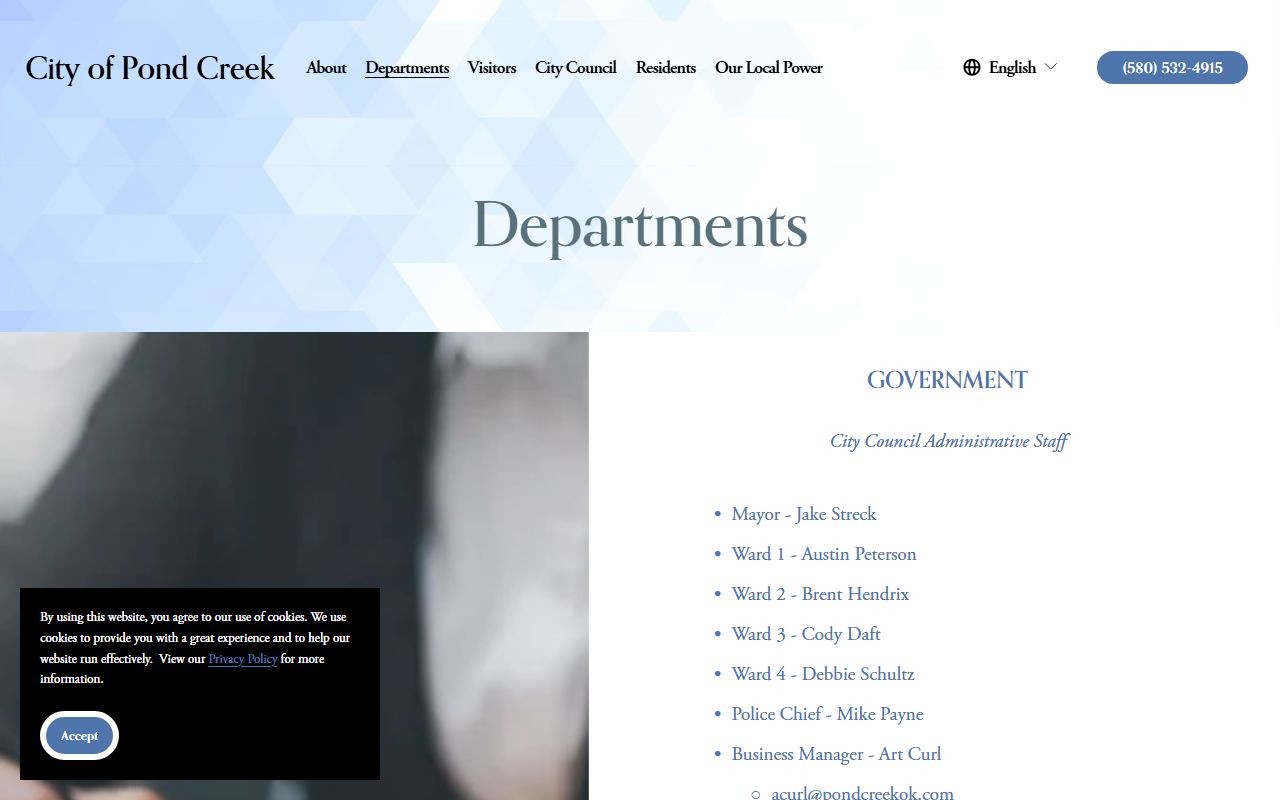
The departments page shows who to reach for city matters when a case is municipal rather than District Court. When you are not sure which court holds a citation, the case number prefix and the issuing agency point you to the right counter.
When to Call the Court Clerk
Online dockets answer most questions, but some cases need a phone call. The Grant County Court Clerk holds files from the early 1900s to the present and can confirm a hearing date, a balance, or a record that never reached the online system. Adrienne Hembree serves as Court Clerk in Room 202 of the courthouse in Medford.
Call when a docket date looks unclear, when a record appears sealed, or when you need a certified copy. Juvenile, mental health, and adoption records are not open to the public, so those require a different path through the District Court rather than a counter request.
Mail and email also reach the office. A written request can go to the post office box in Medford, and the clerk answers questions about copy and certification charges, which are set by the local court rather than by the state.
Note: The Court Clerk can reach the office by phone at 580-395-2828 during business hours, and a case number speeds any docket lookup or copy request.