
How to Search Grant County Court Records
Two official paths reach Grant County case files. The first is the OSCN Docket Search, run by the Oklahoma State Courts Network. The second is On Demand Court Records, known as ODCR, which the Grant County Court Clerk links directly and calls a free site with extensive case information. Both list Grant County District Court in their court menus. OSCN is the better starting point for statewide Oklahoma dockets, and ODCR works well as a second pass for participating courts.
Gather a few details before you start. A case number is the cleanest way in. If you only have a name, a date of birth and a case type help cut down on false matches. Both sites are free to search by name or case number, though scanned document images may carry a fee on ODCR.
- Open the OSCN Docket Search and set County or Court to Grant County District Court. Search by case number first when you have one.
- If you lack a case number, search by party. Enter a last name, then add a first name or date of birth range only if the results are too broad.
- Pick a party type when the name is common, such as Defendant for criminal and traffic cases or Petitioner and Respondent for family and protective order matters.
- Limit by District Court case type when you know the record class. Use CF for felony, CM for misdemeanor, TR for traffic, FD for family, PB for probate, PO for protective order, and SC for small claims.
- Add a filed or closed date range for older or high-volume searches.
- For a District Court traffic citation, use the Citation Number field. OSCN does not search municipal citations, so a city ticket must be checked with the issuing city court.
- Run the same name or case number on ODCR as a second path for Grant County public records.
- If a record predates the online coverage or appears sealed, contact the Court Clerk by phone, mail, email, or in person.
Grant County Court Records Search Fields
The OSCN Docket Search form holds many fields, and most are optional. You can mix and match them to widen or tighten a search. The table below lists the fields a Grant County user reaches most often, with the format notes that keep a search clean.
| Field Label | Type | Required | Notes / Format |
|---|---|---|---|
| County or Court | Dropdown | No | Includes All Oklahoma Courts and Grant County District Court. |
| Case Number | Text | No | Format is type-year-number, such as CF-2025-12 or TR-2026-93. |
| Last Name | Text | No | Party name search. |
| First Name | Text | No | Narrows a common last name. |
| Born On or After Date | Date | No | Date format example 01/01/2010. |
| Party Type | Dropdown | No | Options include Defendant, Plaintiff, Petitioner, Respondent, and more. |
| District Court Case Type | Dropdown | No | Felony, misdemeanor, civil, family, probate, traffic, and others. |
| Cases Filed After Date | Date | No | MM/DD/YYYY format. |
| Citation Number | Text | No | District Court traffic only; does not search city citations. |
ODCR adds its own free options for partial-name, case-number, and filed-date searches across participating courts. Its paid tools list and access tiers appear on the ODCR pricing page, which shows a free docket search alongside paid advanced filters and image access.
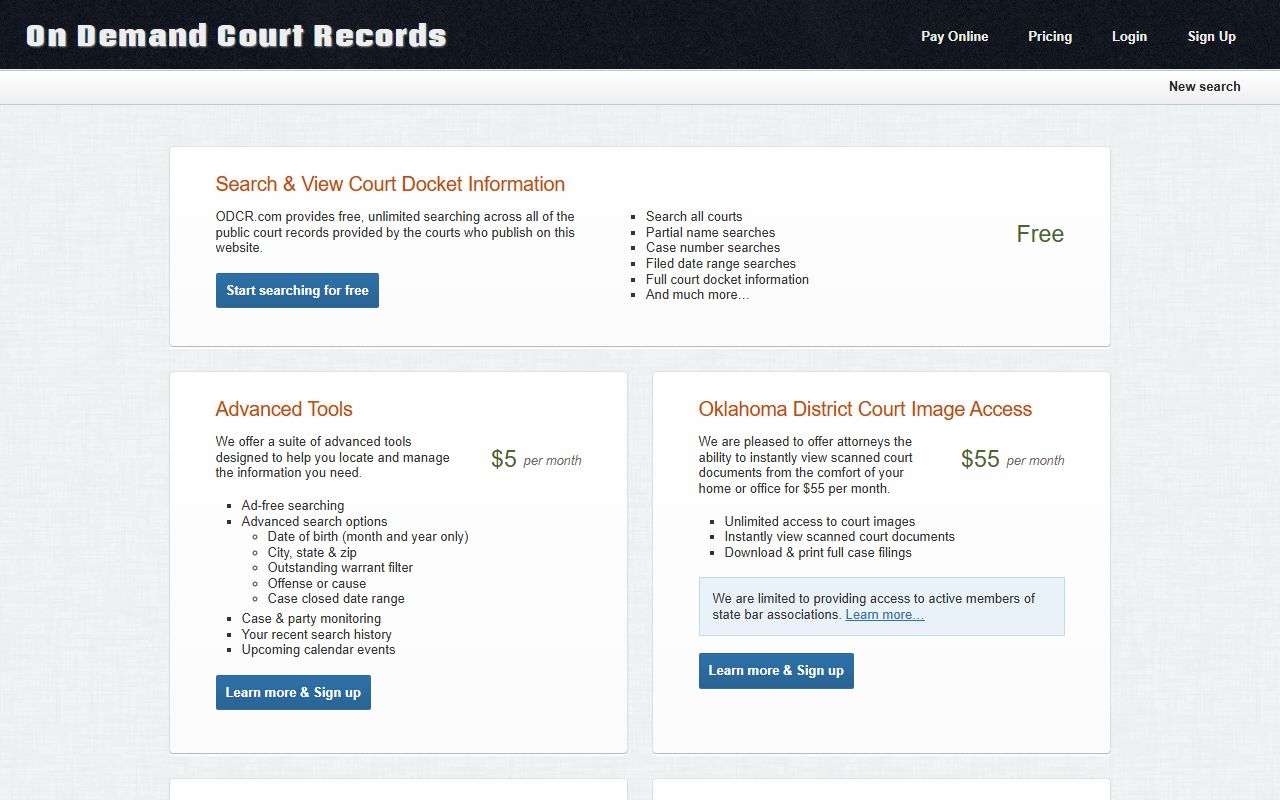
The pricing page confirms that reading docket entries stays free, while advanced filters cost about five dollars a month and full District Court image access is limited to bar members at a higher monthly rate. A single-court image plan sits in between. For most readers, the free docket text answers the question without any paid tier.
Types of Grant County Court Records
Grant County District Court is a court of general jurisdiction. That means one local court handles nearly every kind of state case, from a felony prosecution to a name change. The case type drives the prefix on the case number, and it controls where a record shows up in a search.
The Court Clerk maintains the files for each of these classes. Some, like juvenile and mental health matters, are not open to the public even though the case type exists in the system.
- Civil cases, such as contract disputes, collections, judgments, liens, and name changes.
- Criminal cases, covering felony and misdemeanor charges, pleas, and sentencing.
- Family and divorce cases, including paternity and child support actions.
- Probate, guardianship, trust, and will filings.
- Traffic citations filed in District Court by state or county law enforcement.
- Protective orders and small claims actions.
- Marriage license records, which Oklahoma routes through the Court Clerk.
What Grant County Court Records Show
A docket result is more than a name and a date. It pulls together the parties, the charges or claims, every filing, and the money owed in one running list. The fields below appear across most Grant County District Court files, though a sealed case or a redacted line may hide some of them.
| Field | What It Shows |
|---|---|
| Case Number | Type, year, and sequence, such as CF for felony or PB for probate. |
| Caption | The parties, often the State or a plaintiff against a defendant or respondent. |
| Court and Judge | Grant County District Court and the assigned judge. |
| Filed and Closed Dates | When the case opened and, if finished, when it closed. |
| Parties | Defendant, plaintiff, attorneys, district attorney, and bondsman. |
| Docket Entries | Each filing and event by date, such as information, bond, plea, and order. |
| Disposition | The outcome of a charge or the whole case. |
| Financial Section | Court costs, fees, fines, and any payment plan balance. |
| Calendar Events | Hearing date, time, event type, and completion status. |
Documents may show as image links on the docket, but those scans can require a paid or bar-member account on ODCR. Where a minor victim is named in a criminal case, the docket often lists the person as known to the district attorney rather than by full name.
Public Access Framework for Grant County Court Records
Oklahoma treats court files as open by default. Under 51 O.S. 24A.5, the records of a public body are open for inspection and copying during regular business hours unless another law makes them confidential. The Grant County Court Clerk page states the same rule in plain terms: court files run from the early 1900s to the present, and all court records are public except juvenile, mental health, and adoption matters.
The state library keeps a full list of the open-records sections for anyone who wants the statutory backbone. That index covers 51 O.S. 24A.1 through 24A.30 and is published on the Oklahoma Open Records Act citation list.
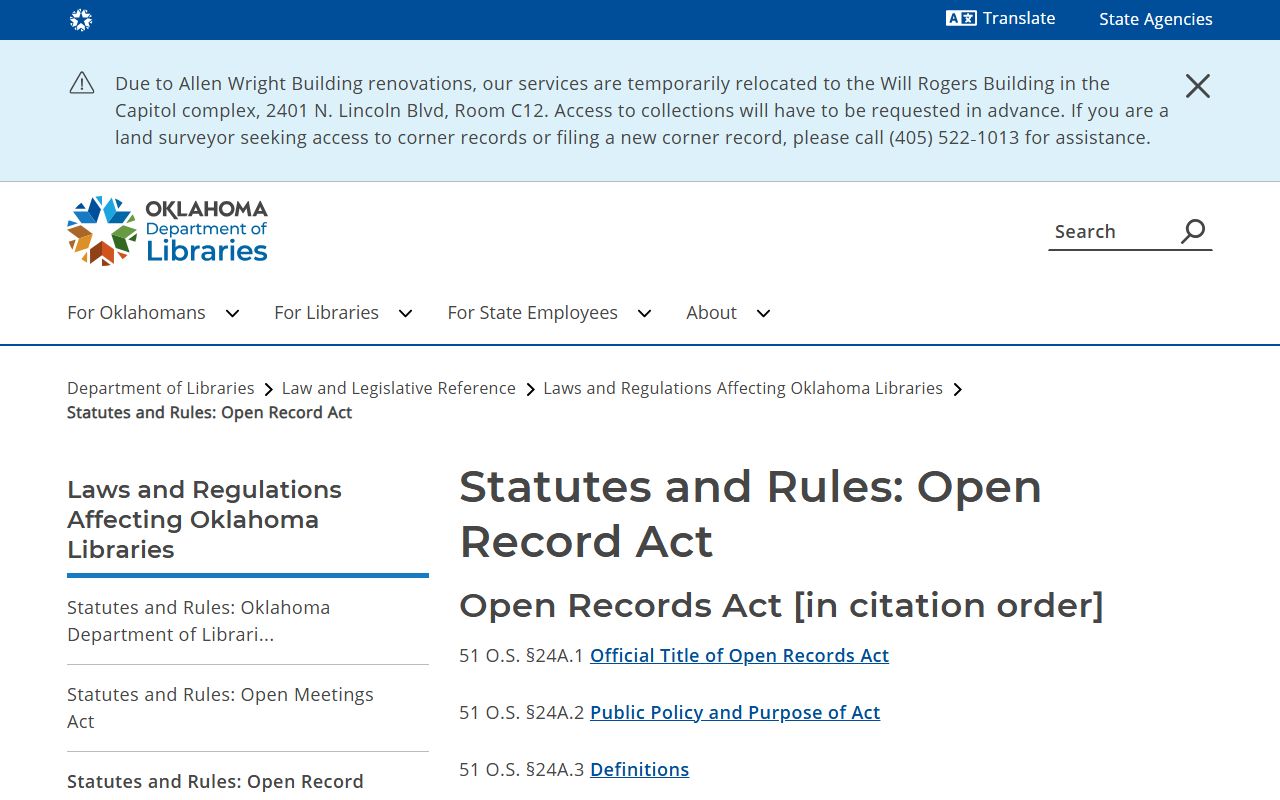
The citation list shows how the Open Records Act is organized and which sections control fees, response times, and exemptions. For most Grant County requests, the practical path is simple: search OSCN or ODCR first, then ask the Court Clerk for anything older, certified, or not posted online.
Note: Public access does not mean free copies; the Court Clerk may charge a per-page fee and a certification fee for paper or certified records.
Sealed and Confidential Grant County Records
Some records stay closed even though the case type appears in the search system. The Grant County Court Clerk excludes three categories from public inspection: juvenile, mental health, and adoption records. These files are not normal public case files, and the counter staff cannot release them without legal authority.
Juvenile confidentiality has a statute behind it. Under 10A O.S. 2-6-102, juvenile records are confidential except where a specific exception allows release. Sealed and expunged criminal records work the same way once a court grants the order, and dockets may also redact Social Security numbers, financial account details, and protected addresses.
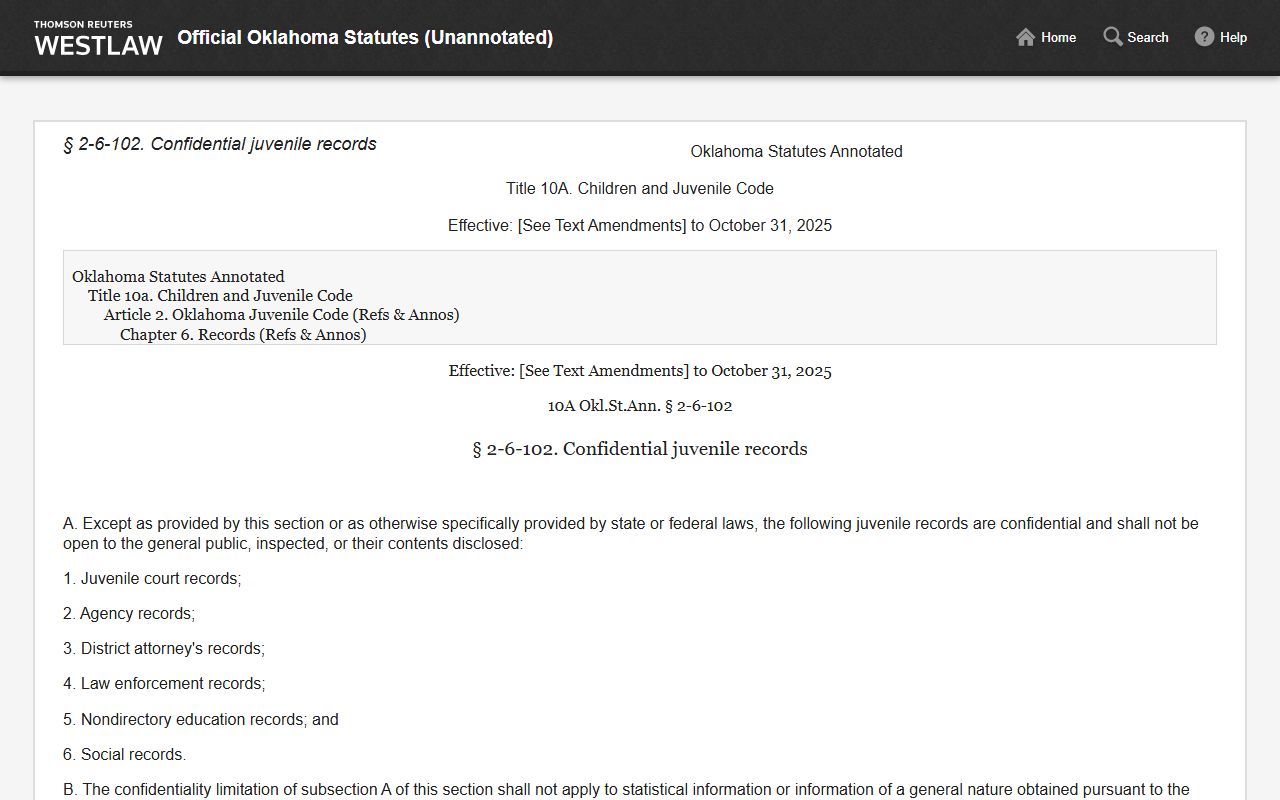
The statute page lays out the narrow exceptions that allow a juvenile file to be shared. To view a sealed or expunged record, a person usually needs statutory eligibility or a court order, and the request runs through the District Court rather than the front counter.
Requesting Records From the Court Clerk
When a record sits in an old paper file, needs certification, or never reached the online system, the Court Clerk is the office to call. Adrienne Hembree serves as Grant County Court Clerk in Room 202 of the courthouse in Medford. Requests can come by phone, by mail to the post office box, by email, or in person at the counter during office hours. Bring the case number when you have it, since it speeds the search.
Grant County Court Clerk
Adrienne Hembree
112 E Guthrie, Room 202
Medford, OK 73759
P.O. Box 9, Medford, OK 73759
580-395-2828
Fax 580-395-2008
8:00 a.m. to 4:00 p.m. Monday to Friday
The clerk can also confirm current copy and certification fees, since court copy charges are set locally and should be verified before you travel. County recording copies through the County Clerk run about a dollar a page and a dollar per certified certificate, but court file copies are a separate matter handled by the Court Clerk.
City Citations and Online Payments
Not every ticket lives in the District Court system. A city ordinance violation or a municipal traffic citation is handled by the city court that issued it. In Medford, that is the Medford Municipal Court, which meets at City Hall and routes fine and case questions through 580-395-2823. OSCN and ODCR will not show those municipal cases, so a city ticket has to be checked with the city.
For District Court balances, Oklahoma offers an online payment route. The OSCN e-Payments service accepts credit and debit card payments for selected District Court cases and approved payment plans. Its search step asks for a case number, citation number, or payment-plan number before it shows a balance.
You can read the full terms and reach the search step through the e-Payments agreement page. The system covers only selected cases and approved balances, so if a case does not appear, the Court Clerk can confirm how to pay. Municipal fines are paid through the city, not through this state tool.